Turn 1 or Turn 3: which Klondike should you play?
Turn 1 is the easier way to play Klondike: you turn one card from the stock at a time, so every card is reachable on every pass. Turn 3 turns over three cards and only lets you play the top one, which makes it harder to win and slower to get through, but it scores more points when you do win.
Our Klondike game starts in Turn 1, and the Draw button under the table switches to Turn 3. Here’s how the two compare.
What are the main differences?
| Turn 1 | Turn 3 | |
|---|---|---|
| Cards turned per tap of the stock | 1 | 3 |
| Which waste card you can play | Every card, as it comes up | Only the top card of each group |
| Deals that can be won with perfect play | about 90% | about 82% |
| Deals won in our test | 11.6% | 2.7% |
| Moves in a won game, our test | 126 | 123 |
| Passes through the stock in a won game, our test | 3 | 7 |
| Points lost for going round the stock again | 100 each time | none |
| Score of a won game, our test | 530 | 700 |
| Passes allowed in Vegas scoring | 1 | 3 |
The perfect-play figures come from research by the University of St Andrews, explained in our post on the odds of winning Solitaire. The test figures are medians from our own run, described below.
What is the difference between Turn 1 and Turn 3?
It’s all in the stock, the face-down pile at the top left. The columns, the foundations and the rest of the rules are the same.
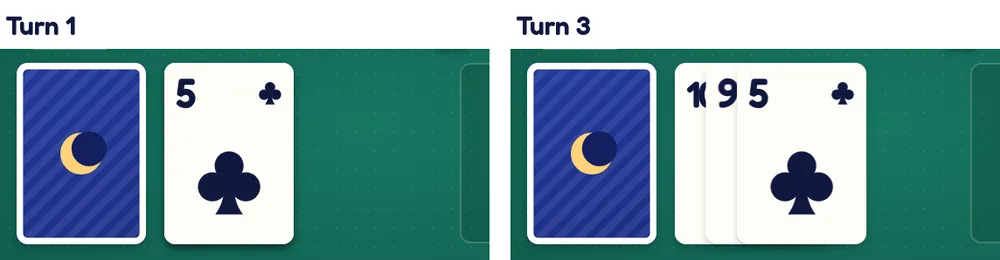
In Turn 1, each tap turns over one card, and you can play it straight away. Every card in the stock comes up on every pass, one at a time.
In Turn 3, each tap turns over three. Only the top one can be played. The two underneath are stuck until you play the one above them. If you can’t, they stay buried, and on the next pass they come round in the same group again.
There’s a way round that. Each card you play from the waste shifts the groups of three by one on the next pass, so a card that was stuck in the middle can come up on top. Our Klondike Turn 3 page has tips on doing that on purpose.
Which one is easier to win?
Turn 1, by a wide margin.
Even with perfect play and every card known, about 90% of Turn 1 deals can be won, against about 82% of Turn 3 deals. In a real game you can’t see the face-down cards, so both figures come out lower, and the gap gets wider.
To see how much wider, we ran a test. A simple program played the same 5,000 deals twice, once in each mode. It followed the habits from our Klondike strategy post, only used cards it could see, and never used Undo. It won 11.6% of the deals in Turn 1 and 2.7% in Turn 3. That’s more than four times as many wins in Turn 1.
A good human player who thinks ahead and uses Undo will win far more often than our program in both modes. The point of the test is the gap between them.
Does Turn 3 take longer?
Not in moves, but in trips through the stock.
In our test, a won game took 126 moves in Turn 1 and 123 in Turn 3. Those counts include every tap of the stock, as our game’s Moves counter does.
The difference is how often you go round. A won Turn 1 game went through the stock 3 times. A won Turn 3 game took 7. In Turn 3 you’re often waiting for the groups to shift, so you spend more of the game cycling the stock and less of it moving cards in the columns.
How does scoring change?
The points for each move are the same in both modes: 10 for a card to a foundation, 5 for a waste card to a column and 5 for turning over a face-down card. The home page has the full scoring table.
The difference is the stock. In Turn 1, turning the waste back over to start a new pass costs 100 points. In Turn 3 it’s free.
That’s why, in our test, a won Turn 3 game scored more: 700 against 530. The Turn 1 games lost points every time they went round again.
Vegas scoring works differently again. You start at -$52 and earn $5 per card on a foundation, and the number of passes is limited: one in Turn 1, three in Turn 3. You can try it on our Vegas Solitaire page.
Why would anyone choose the harder one?
Because the extra difficulty is the fun part for some players.
Turn 3 adds a second puzzle on top of the columns: getting the right card to the top of its group. Planning which waste card to play, and when, so that the next pass lines up the card you need is a real skill. You’ll lose more games, but a win means more.
The higher score also matters if you play to beat your best.
Which one should you play?
Play Turn 1 if:
- You’re new to Klondike, or coming back to it after a long time.
- You want to win more often.
- You like a relaxed game you can finish in one sitting.
- You’re learning strategy and want to see every card.
Play Turn 3 if:
- You win most Turn 1 games and want more of a challenge.
- You enjoy planning several moves ahead.
- You play for a high score.
- You learned on Turn 3 and it feels like the real game to you.
Not sure? Start in Turn 1, and switch with the Draw button once you’re winning more often than not. For the basics of the table, see how to play solitaire.
Questions people ask
- Is Turn 3 the same as Draw 3?
- Yes. Turn 3 and Draw 3 are two names for the same rule: three cards come off the stock each time, and only the top one can be played. Turn 1 is also called Draw 1.
- Can I switch between Turn 1 and Turn 3 in the middle of a game?
- Yes. Press the Draw button under the table. The next time you tap the stock, it uses the new setting. The game also remembers your choice for next time.
- Which is better for beginners?
- Turn 1. You see every card in the stock on every pass, so you can learn how the columns work without the extra puzzle of the groups of three.